How to Delegate Tasks to AI Agents
Foundations & team design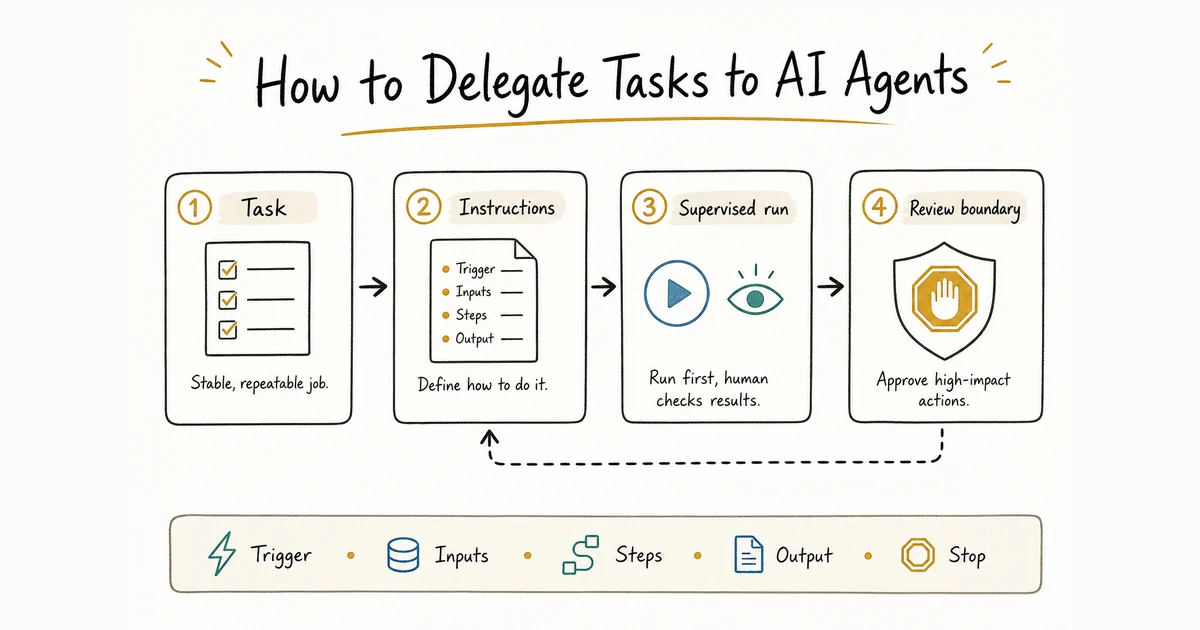
A conceptual loop for delegating work to AI agents: task, instructions, supervised run, output, and review boundary. Not a product screenshot.
How to delegate tasks to AI agents is less about finding a smarter model and more about packaging work. A task is ready to delegate when an agent can start from a clear trigger, follow specific instructions, produce a defined output, and stop when review is required.
Most failed handoffs look the same. The ask is too broad. The steps live only in someone's head. The agent gets tools before it gets a finish condition. Then the human stays in the loop anyway, rewriting every draft.
This guide is a practical method for coding-agent work: bug reports, release notes, documentation updates, scheduled briefs. If you are still deciding whether you need an agent at all, start with AI agent vs chatbot.
What counts as a delegable task
A delegable task is a job with five parts:
- Trigger: what starts it, such as a new issue, a merged PR, a calendar event, or a Monday brief
- Inputs: the files, links, logs, or prior decisions the agent may use
- Steps: the sequence the agent should follow
- Output: the artifact the next person or system expects
- Stop condition: when the agent must pause, ask, or refuse to guess
Look. If you cannot write those five parts down, the task is still yours. The agent is not the problem yet.
Good first candidates for coding agents:
- Turn a reproducible bug report into an investigation brief and draft PR
- Draft release notes from merged changes for human approval
- Flag docs pages that drifted after a command or API change
- Produce a scheduled research or dependency brief from known sources
Poor first candidates:
- "Make the product better"
- Open-ended voice writing with no brief
- Work that changes rules every week
- Decisions that need taste, negotiation, or live judgment
How to delegate tasks to AI agents in 5 steps
1. Pick one boring, stable job
Start with the task you already repeat. The less creative it is, the easier the handoff.
One task. Not a whole backlog. A weekly release notes draft is better than "own releases." A single bug-to-PR path is better than "maintain the repo."
2. Do it manually once and capture the real steps
Before you write agent instructions, run the task yourself and write what you actually did. Include the awkward parts: which file you opened first, which check you skipped, what "done" looked like.
Honestly, this step is the one people skip. Then they blame the agent for missing context they never wrote down.
3. Turn the steps into instructions with examples
Vague instruction:
Handle this bug.Delegable instruction:
Trigger: new bug report labeled "needs-repro"

Goal: prepare an investigation brief and a draft fix for human review

Inputs:
- issue body and comments
- failing test or reproduction notes, if present
- related files mentioned in the report

Steps:
1. Restate the user-visible failure in one sentence.
2. Reproduce or explain why reproduction failed.
3. List likely files and constraints.
4. Propose the smallest patch that addresses the reported failure.
5. Note tests run and tests skipped.

Output:
- investigation brief
- draft patch or PR description
- open questions

Stop if:
- expected behavior is a product decision
- reproduction is impossible with current info
- the fix would change public API without approval
The second version gives the agent a job, not a vibe.
4. Run supervised before you trust the loop
For the first runs, review every output. Check whether the agent followed the steps, invented missing facts, or skipped the stop condition.
Trust comes from repeated evidence, not from a confident tone. If the output keeps needing heavy edits, tighten the instructions. Do not expand scope.
5. Keep a review boundary
Delegation is not abandonment.
Keep a person in the path for:
- merging production-facing code
- publishing release notes
- customer replies that make commitments
- anything involving money, legal language, or security disclosure
Agents can prepare the work. People should still own irreversible decisions.
What's the best way to delegate a multi-day coding task to an AI agent?
Do not hand over a week of work as one vague prompt. Slice it.
- Write a definition of done for today’s slice, not the whole epic
- End each day with branch or commit, decisions made, checks run, and open questions
- Start the next day from that package, not from memory
- Schedule a human checkpoint before merge, release, or API changes
Multi-day work fails when the agent optimizes for activity instead of checkpoints. Approvals, exceptions, and handoffs to people belong in the stop conditions. For team-level operating rules, see how to run an AI agent team that stays on track.
What needs human approval when you delegate tasks?
Keep the approval line explicit before the work starts.
- Merges that change production behavior
- Releases, public changelogs, and customer-facing notes
- Messages that make commitments on timing, pricing, or support
- Anything that sends, spends, publishes, or changes legal expectations
The agent can prepare the draft, collect evidence, and tee up the decision. Approval is still a separate step. If the boundary lives only in your head, the handoff is incomplete.
How do you delegate user authority to AI agents?
Addressing is who may ask an agent for work. Authority is what the agent is allowed to do with tools and credentials. Approval is the last gate for actions that should pause before they affect another person or system.
A teammate can @mention your agent in a shared room without inheriting your local secrets. The request does not expand permissions. The agent may answer, draft, refuse, or ask you to approve. Keep owner-defined tools and approval boundaries intact. The room-protocol view of that split is in humans and AI agents in one room.
In practice, those three lines should stay separate:
- who can ask
- what the agent is permitted to do
- which outcomes still stop for human approval
When those lines blur, teams think delegation failed. Usually the method failed first.
Instruction patterns that hold up
Strong instructions usually include:
- Exact trigger timing or event
- Allowed tools and forbidden actions
- Output shape, with a short example
- Quality bar, such as "no claims without a source link"
- Failure path when inputs are incomplete
For a docs refresh task, that might mean: scan changed CLI commands, list affected pages, draft a patch, then stop for human wording review. For a Monday brief: collect only from an approved source list, separate facts from unknowns, and leave strategy recommendations out.
If the task later needs multiple roles, move from one agent to AI orchestration or a fuller AI agent team. Patterns like bug-to-PR and docs refresh also map cleanly to the multi-agent workflow patterns guide.
Common failure modes
Inconsistent output. The instructions leave too much style and judgment open. Add an example of a good result and a bad result.
Constant breakage. The task has too many exceptions. Narrow it until the happy path is boring.
No real handoff. Someone still rewrites the whole artifact every time. Either the task was never stable, or the review boundary is too late.
Silent guessing. The agent fills gaps instead of stopping. Write the stop conditions as hard rules, not polite suggestions.
Too much access too early. Start with read-only or draft-only mode when the action can send, publish, or mutate important systems.
A short checklist before you hand work off
Ask:
- Can another person follow these instructions without asking you for context?
- Is the output recognizable without a meeting?
- Does the agent know when to stop?
- Is the first version narrow enough that failure is cheap?
- Who reviews irreversible actions?
If any answer is fuzzy, keep the task with a human for one more cycle.
Where Alook fits
Alook is one way to keep delegated coding-agent work organized once the method is clear: roles, persistent message threads, and recorded context. The method still comes first. Without a delegable task definition, any platform just automates confusion faster.
How to delegate tasks to AI agents FAQ
How do you delegate tasks to AI agents?
Pick one stable, repeatable task. Write instructions with inputs, steps, output format, and stop conditions. Run the agent supervised until the output is reliable, then keep a review boundary for high-impact actions.
What's the best way to delegate a multi-day coding task to an AI agent?
Break the job into checkpoint-sized slices with a written definition of done for each slice. Carry branch, decisions, and open questions forward. Review at each checkpoint. Keep merge and release behind a human.
How do you delegate user authority to AI agents?
Separate addressing from authority. Others may request work when the room allows it; tools, credentials, and approvals stay with the runtime owner. A request should not silently expand what the agent can do.
What needs human approval when you delegate tasks to AI agents?
Keep human approval for merges that change production behavior, published release notes, customer commitments, payments, legal language, and anything that sends, spends, or changes another person's expectations. The agent can prepare the work, but approval is still a separate step.
What makes a task good for AI agent delegation?
A good task has a clear trigger, known inputs, a recognizable output, few judgment calls, and a safe place to pause when information is missing. Vague goals and taste-heavy work are poor first candidates.
Should AI agents run without human review?
Not for high-impact actions. Start with supervised runs. Keep human approval for customer commitments, production changes, payments, legal language, and anything that changes another person's expectations.
What is the difference between delegating to a chatbot and an AI agent?
Delegating to a chatbot usually means prompting for a reply. Delegating to an AI agent means assigning a goal with tools, state, a trigger, and a review boundary so the work can continue beyond one chat turn.
Start with one task you already know how to finish by hand. Write the five parts. Supervise the first runs. Expand only after the handoff is boring.