AI Agent vs Chatbot: What's the Difference?
Foundations & team design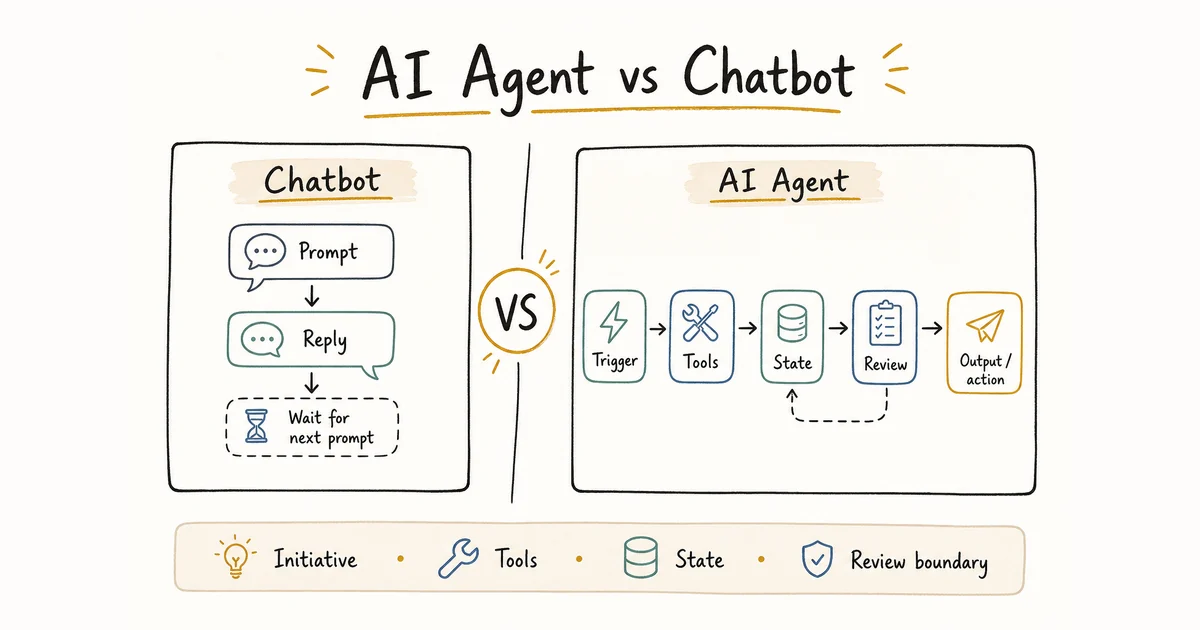
A conceptual comparison of chatbot vs AI agent flow. Not a product screenshot.
AI agent vs chatbot is mostly a question of initiative. A chatbot waits for you to ask. An AI agent can keep working toward a goal after you define the job, the tools it may use, and the rules for when it should stop or ask for review.
That split matters more than branding. Many products call everything an "agent." Some chatbots can call tools. Some agents still talk like chatbots. The useful test is what each one is designed to do without another prompt from you.
What is a chatbot?
A chatbot is a conversational interface to a model. You send a message. It replies. The next step usually waits for you again.
Chatbots are strong when the work is interactive:
- Explaining a concept
- Drafting text you will edit immediately
- Comparing options in a back-and-forth
- Analyzing something you just pasted
- Exploring an idea before the requirements are stable
They are weaker when the job needs continuity. A new thread often starts cold. Long multi-step work depends on you remembering what happened last time, pasting context again, and deciding the next action.
Customer support bots, product chat widgets, and general assistants like ChatGPT or Claude in chat mode all sit in this family, even when they feel sophisticated.
What is an AI agent?
An AI agent is software that pursues a goal through steps, not only through replies. A useful agent usually has more than a prompt box:
- A goal with a finish condition
- Tools it can call, such as a codebase, browser, email, or API
- State that survives across steps
- A trigger that can start work, such as a schedule, webhook, new issue, or inbox item
- A review boundary for actions that need a person
Coding agents are a clear example. Claude Code, Codex, and OpenCode can investigate a repository, change files, run commands, and report results. The conversation may still exist, but the point of the system is to complete work, not only to chat.
An agent is not magic autonomy. Poor goals, missing permissions, and unclear stop conditions produce brittle runs. The design of the workflow matters as much as the model.
AI agent vs chatbot side by side
| Dimension | Chatbot | AI agent |
|---|---|---|
| Starts work | After a human prompt | After a prompt, schedule, event, or queue item |
| Main output | A reply | An artifact or completed action |
| Context | Often session-bound | Can keep durable state across runs |
| Tools | Optional and usually prompt-driven | Central to the job |
| Failure mode | Weak answer | Incomplete or wrong action |
| Best fit | Exploration and one-off help | Repeatable work with clear boundaries |
The failure modes are different. A bad chatbot answer wastes a few minutes. A bad agent action can open a pull request, send a message, or change a system. That is why agents need narrower scope and clearer review points.
Common confusion around AI agent vs chatbot
A chatbot with tools is still mostly a chatbot if every run begins with you pasting context and choosing the next step. Tool use alone does not create agency.
An agent that chats is still an agent if chat is only the control surface. The important part is whether it can execute a defined job with tools and state.
"Autonomous" does not mean unsupervised. Agents should pause on high-impact decisions: customer commitments, production changes, payments, legal language, and anything that changes someone else's expectations.
Scheduling is one signal, not the whole definition. Many agents run on a schedule. Some start from an event. Some wait for a human kickoff but then complete several tool-using steps before returning. The shared trait is goal-directed work beyond a single reply.
When to use a chatbot vs an AI agent
Use a chatbot when:
- The task is one-off
- Requirements are still fuzzy
- You need to steer every turn
- The output is advice or draft text for immediate review
- There is no durable workflow worth encoding
Use an AI agent when:
- The same job repeats
- Inputs and outputs are known
- Multiple tools or systems are involved
- State should persist between runs
- A trigger can start the work without another full briefing
Many teams use both. A chatbot helps shape the plan. An agent executes the stable parts. If the work later needs several specialized roles, move from one agent to AI orchestration or an AI agent team.
A short decision test
Ask four questions:
- Does this job start without a fresh human prompt each time?
- Does success mean an action or artifact, not only an answer?
- Does the system need tools and memory beyond one chat thread?
- Can a person define when it must stop or ask for approval?
If most answers are no, stay with a chatbot. If most answers are yes, design an agent workflow. For the handoff into real task design, read how to delegate tasks to AI agents.
AI agent vs chatbot FAQ
What is the difference between an AI agent and a chatbot?
A chatbot responds to prompts inside a conversation. An AI agent pursues a goal, can use tools, keep state across steps, and may run from a trigger such as a schedule, webhook, or new issue.
Is ChatGPT a chatbot or an AI agent?
ChatGPT is primarily a chatbot: you ask, it replies. Some features can look agent-like when they use tools or multi-step flows, but the default interaction is still reactive conversation.
Can a chatbot become an AI agent?
A chatbot can sit inside an agent workflow as the interface for questions. It becomes closer to an agent only when it has a durable goal, tools, persistent state, and a way to start work without a fresh human prompt each time.
When should you use a chatbot instead of an AI agent?
Use a chatbot for one-off questions, brainstorming, explanation, and fast iteration. Use an AI agent when the work repeats, has a clear output, and benefits from tools, memory, or a scheduled trigger.
If you later need agents that keep working as a coordinated setup, Alook is one option for that layer. The first choice is still simpler: pick chatbot for conversation, agent for goal-directed work.