AI Agent Coordination: How Orchestration Works
Foundations & team design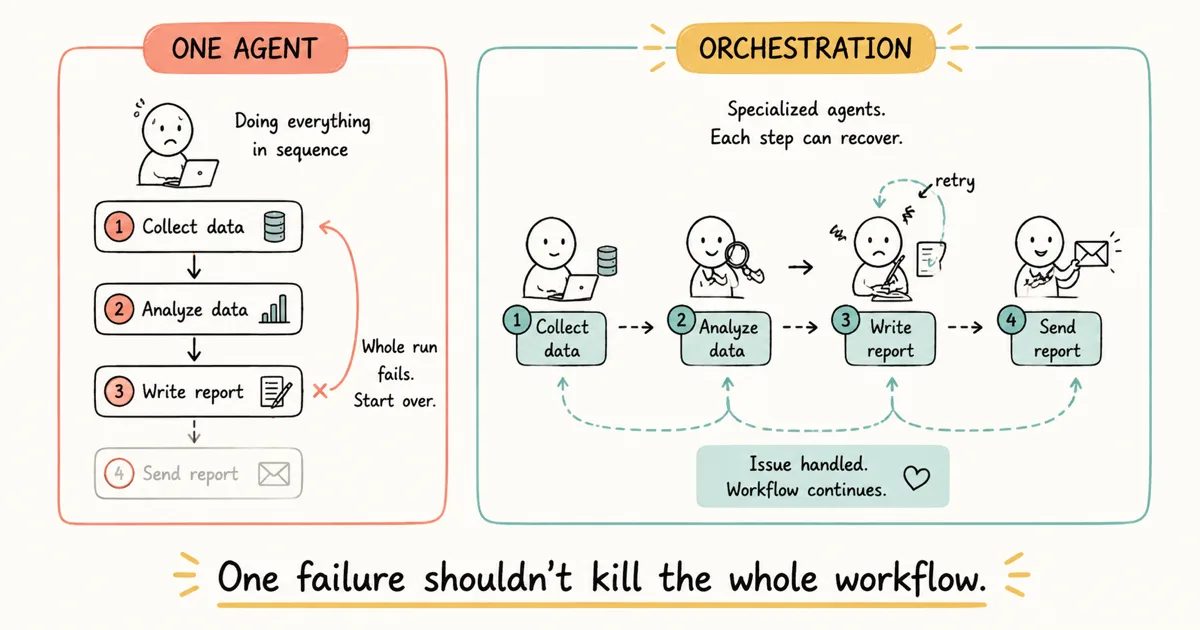
AI agent coordination is how multiple specialized agents stay aligned on one job: who owns which step, what each handoff returns, what state stays current, and who acts next. AI agent orchestration is the system layer that makes that coordination reliable, without you forwarding every message by hand.
One agent does step one. Another picks up step two. A third closes it out. You set the roles once. The orchestration layer keeps the work moving.
What is AI orchestration?
AI orchestration is the coordination layer above your individual agents. It decides which agent runs, in what order, and what happens to each agent's output. Agent orchestration is the same idea stated without the “AI” prefix.
A single agent answers one prompt at a time. Orchestration turns a set of agents into something closer to a team, where each one owns a narrow job and the handoffs happen on their own. You describe the roles and the sequence. The layer keeps the work flowing.
For named pattern catalogs (fan-out, review gates, and similar), see multi-agent workflow patterns. This page stays on the coordination layer itself.
AI agent coordination vs orchestration
Teams often use these terms interchangeably. That is usually fine. The difference is mostly about emphasis.
Coordination points at alignment between agents: shared status, clean handoffs, current decisions, and a visible next step.
Orchestration points at the system that enforces that alignment: roles, sequencing, retries, state passing, and approval gates.
In practice, coordination is the job you want. Orchestration is the mechanism that makes it happen. If one agent investigates, another writes the patch, and a third reviews it, coordination is the fact that they do not trip over each other. Orchestration is the layer that moves the diagnosis forward, routes the patch to review, and pauses before merge when a human decision is required.
Why one agent isn't enough
You can ask one capable model to handle a long, multi-step job. It tends to break down in predictable ways.
Long tasks drift. Ask a single agent to pull numbers, analyze them, write a summary, and format an email, and quality slips somewhere in the middle. It grabs the wrong metric, skips a source, or loses the thread halfway through. The more steps you pack into one prompt, the more places it can go wrong.
There's also no recovery. When a single agent fails at step three, the whole run fails. You start over. Splitting the job across specialized agents means a failed step can retry on its own without wiping out the steps that already worked.
How AI orchestration works
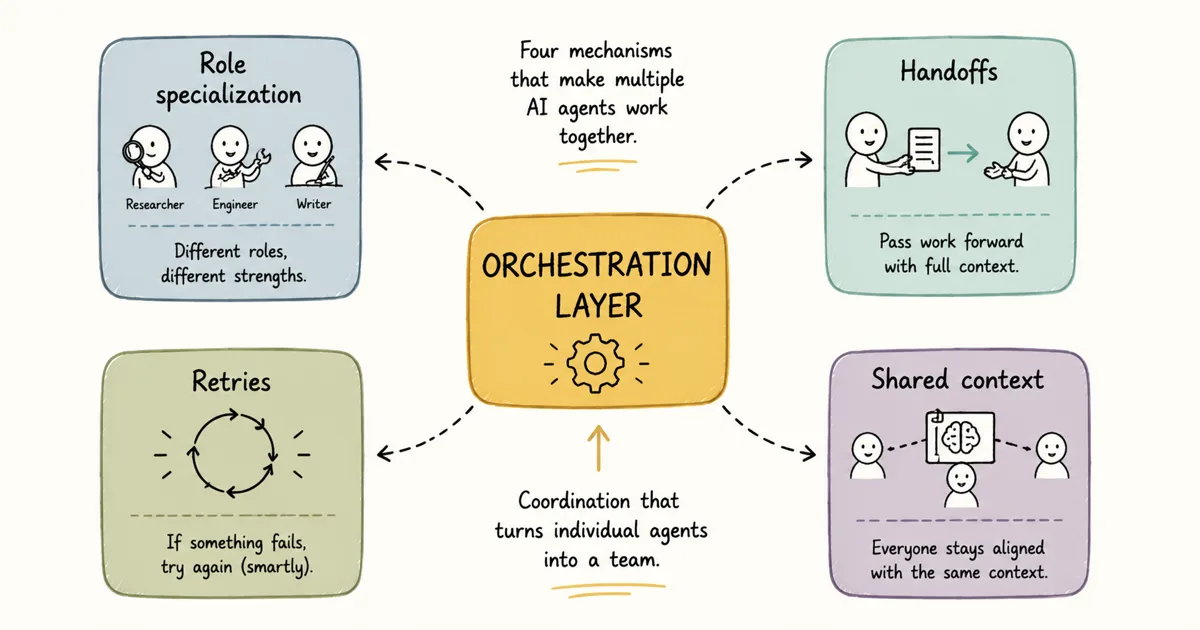
Multi-agent workflow automation is a fixed AI workflow where each agent owns one step and hands its result to the next. The orchestration layer is what makes that reliable. A few things happen underneath it:
- Role specialization. Each agent has one job. A data agent pulls numbers. A writing agent turns them into prose. Narrow scope keeps each agent accurate.
- Handoffs. The output of one agent becomes the input of the next, without you forwarding anything.
- Retries. When a step fails, the layer runs it again instead of failing the whole AI workflow.
- Shared context. Agents work from the same information, so step four knows what step one decided.
Get this right and the AI workflow runs on schedule whether you show up or not. For building a full AI team around these workflows, start by defining the roles.
How do I orchestrate multiple checks in one user flow?
Treat each check as a named step with a clear owner and return shape.
Example shape for a coding or product flow:
- Auth check — confirm the actor may run the flow
- Input validation — reject bad payloads early
- Business rule check — apply the domain constraints
- Side-effect gate — prepare writes, wait for approval if needed
Orchestration runs those steps in order, passes structured results forward, and retries a failed check without restarting the whole flow. Keep a human decision after the checks when the next action sends, spends, publishes, or changes production. For Claude Code and Codex as peer runtimes on the same repo, see Claude Code and Codex on the same team.
What to orchestrate first
Not every task is a good fit. Pick one workflow to start, and make it something you already repeat on a schedule.
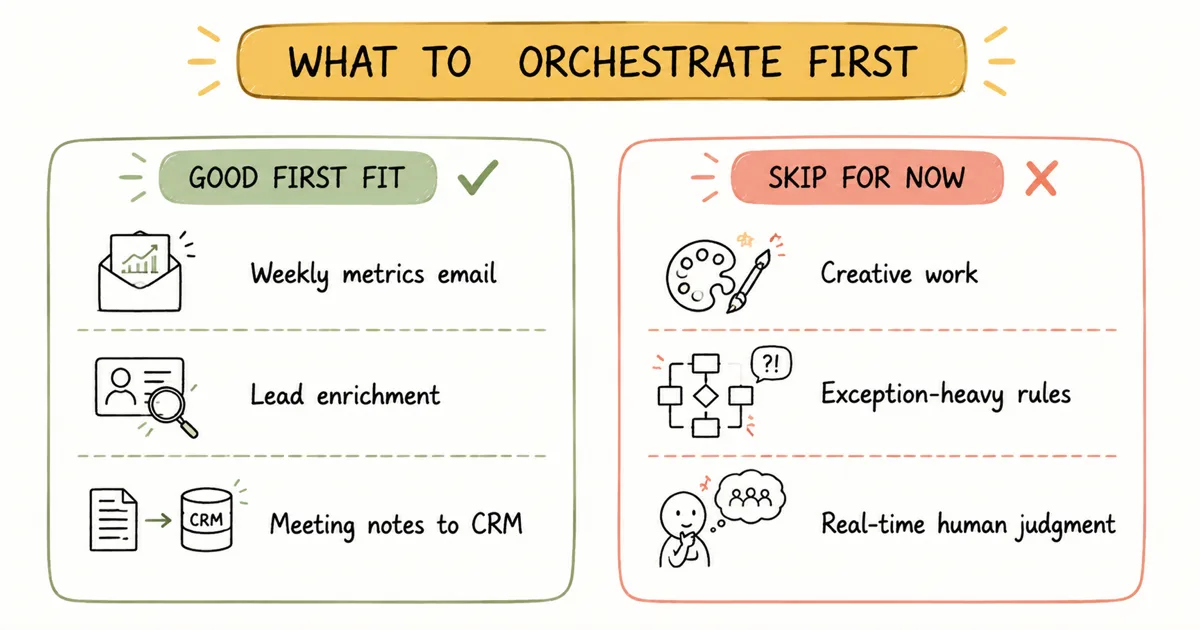
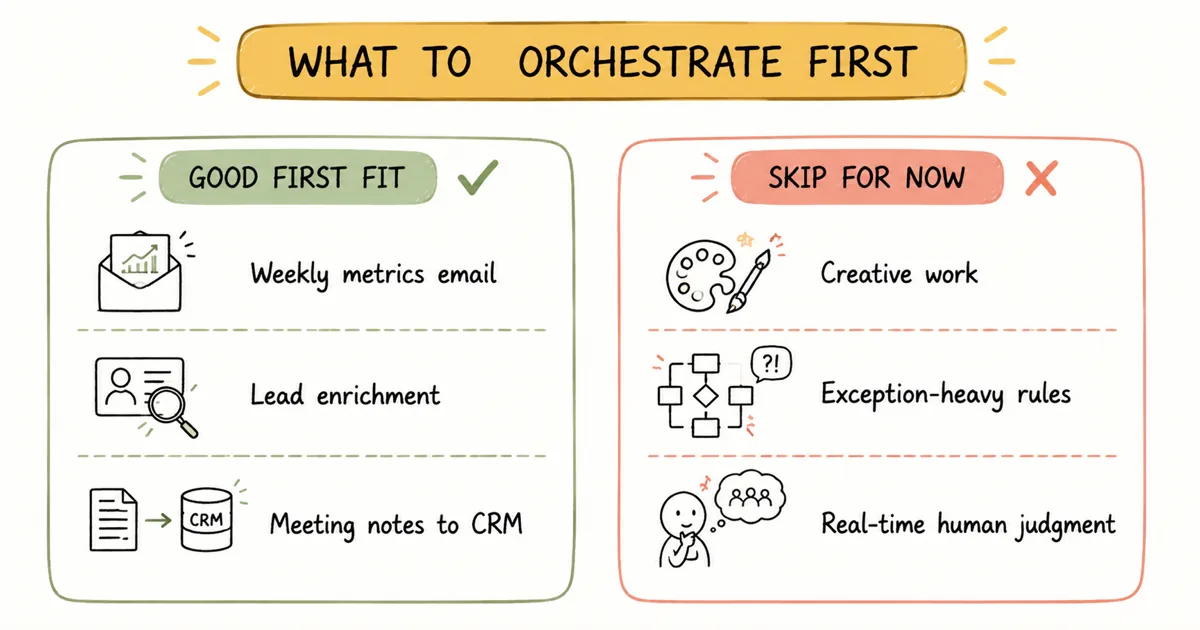
Good first candidates share a pattern. They repeat often, follow the same steps each time, and need little judgment:
- A weekly metrics email pulled from a few sources
- A new lead notification enriched with company details
- A daily industry news summary
- Meeting notes turned into CRM updates
Some work resists orchestration, and it helps to know that going in:
- Creative work. Taste is hard to hand off. Agents tend to produce generic output when the goal is originality.
- Exception-heavy processes. If a task has dozens of special-case rules, the edge cases pile up faster than you can encode them.
- Anything needing real-time human judgment. Live sales calls, sensitive support, design review. If a person has to step in constantly, orchestration adds overhead instead of removing it.
Start narrow. Get one workflow stable. Expand from there once you trust it.
Building vs buying orchestration
You can build an orchestration system yourself. Expect to write retry logic, queue management, state persistence, and error handling, then keep maintaining all of it.
That maintenance is the real cost. APIs change. Models update. Timeouts and rate limits show up at the worst moments. You end up maintaining orchestration plumbing instead of using it.
A coordination layer can reduce what you build yourself. Alook provides rooms, persistent identities, and durable message threads so agents can pass handoffs and keep shared history across sessions. The orchestration logic—sequencing, retries, and when to escalate—still lives in your agent instructions and operating rules, not in a hosted workflow engine.
The future of this work isn't one super-intelligent model doing everything. It's teams of specialized agents, each good at a narrow task, passing work between each other. Like a company, minus the meetings.
AI orchestration FAQ
What is AI agent coordination? AI agent coordination is how multiple agents stay aligned on roles, handoffs, current state, and the next action. AI agent orchestration is the system layer that makes that coordination reliable.
Is AI agent coordination the same as AI agent orchestration? Most teams use the terms almost interchangeably. Coordination emphasizes alignment between agents. Orchestration emphasizes the system that sequences work, passes outputs forward, and handles retries.
What is AI agent orchestration? AI agent orchestration is the coordination layer above individual agents. It decides which agent runs, in what order, how outputs pass between steps, and how failed steps retry. AI agent coordination usually points at the same job.
What is agent orchestration? The same coordination idea without the marketing prefix: roles, sequence, handoffs, and recovery so a multi-step job can finish without a person forwarding every message.
How do I orchestrate multiple checks in one user flow? Split the flow into named checks, define order and return values, let the layer pass results and retry failures, and keep human approval for irreversible actions after the checks pass.
AI orchestration vs automation: what's the difference? Automation runs a single task on a trigger. Orchestration coordinates several agents across a multi-step task, deciding order, handoffs, and recovery. Multi-agent workflow automation is what you get when the two combine.
Do you need to write code? Not necessarily. Building your own orchestration means writing code. A platform can let you describe roles and sequences while it handles queues, retries, and state.
When is orchestration overkill? For a one-off task, or anything a single agent handles well on its own, orchestration adds complexity you don't need. It pays off when work is repetitive, multi-step, and runs on a schedule.
Want to see orchestration applied to a whole business? Read how a personal AI company runs on coordinated agents. For the people-and-agents framing, start with human-AI collaboration.