AI Team vs AI Tools: Stop Being the Human Copy-Paste Between Your Coding Agents
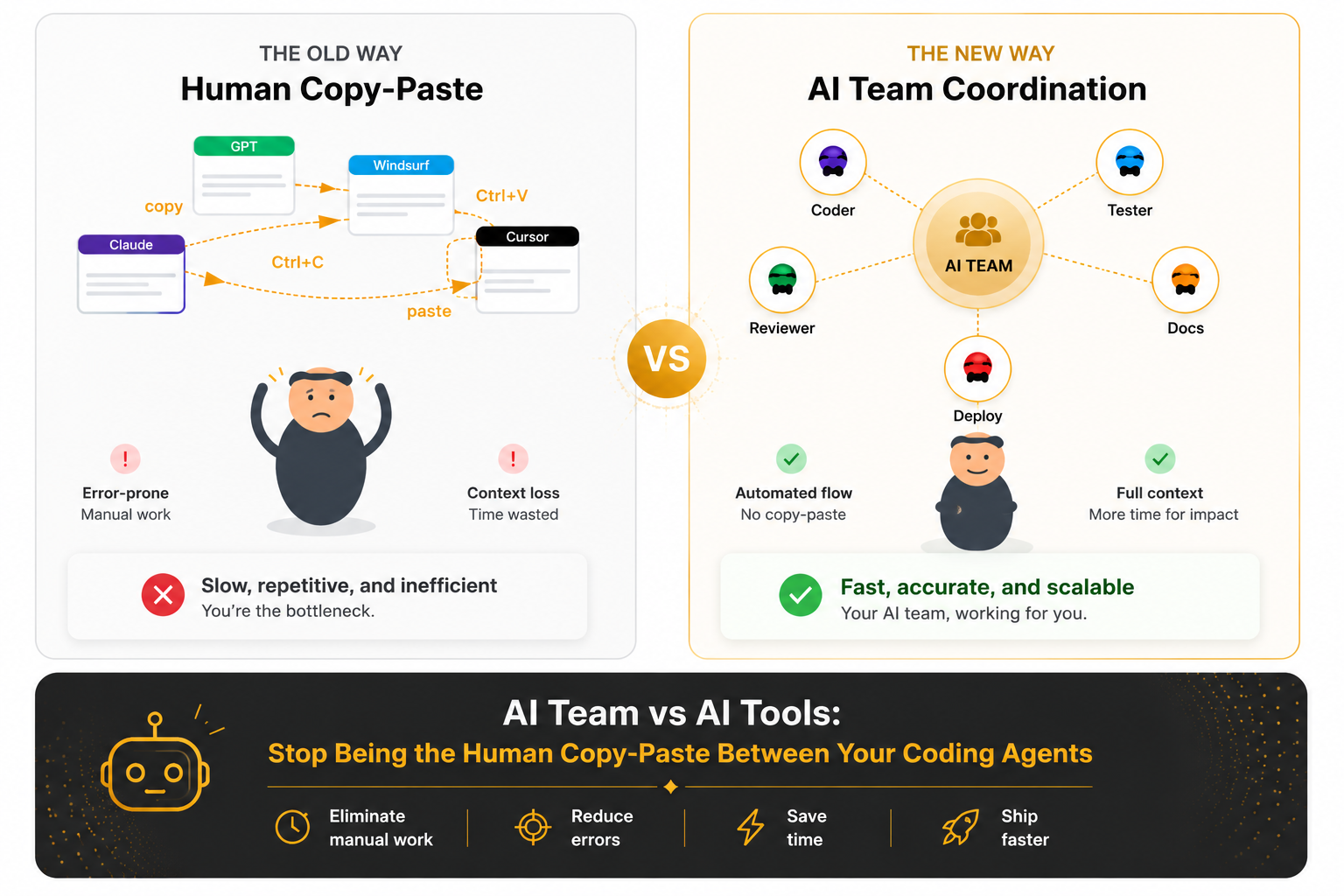
You start a project in Claude Code. It builds the initial architecture beautifully.
Then you need to refactor something complex, so you copy the code to Cursor for its multi-file editing.
Later, you want to test a different approach, so you paste everything into Windsurf.
By the end of the day? Three different versions. Inconsistent implementations. And you're sitting there trying to merge suggestions from tools that have zero idea what the others just recommended.
I've been there. Actually, I was there last Tuesday. You're not using AI tools. You're being used BY them.
The Hidden Cost of Context Switching
Research on interrupted knowledge work shows higher stress and faster but more fragmented work (Mark et al., CHI 2008). A figure often quoted in productivity writing — about 23 minutes to return to interrupted work — comes from a 2006 Gallup interview with Gloria Mark. That number is widely repeated but does not appear in a peer-reviewed paper.
Let me walk you through what my typical day used to look like:
- Morning: Claude Code for new feature, then copy context
- Midday: Cursor for refactoring, paste everything, explain again
- Afternoon: Windsurf for debugging, re-explain the entire codebase
- Evening: Back to Claude Code, completely lost the original context
Four switches. That's basically an hour and a half gone. Just... gone.
But honestly? The time loss isn't even the worst part. Each tool is solving in complete isolation.
Why Isolated Tools Make Everything Worse
What Actually Happens (AI Tools Reality)
So you're building a payment system. I'll use a real example from last month.
Claude Code Session: Started strong. Designed the payment architecture, suggested Stripe integration, created the initial models. Felt productive. Closed my laptop feeling good.
Cursor Session (2 hours later): Pasted the code. Cursor looked at it and immediately suggested a different architecture. Actually recommended PayPal instead of Stripe. Started refactoring everything. It had no idea why I chose Stripe in the first place (regulatory requirements, but how would it know?).
Windsurf Session (next day): This is where it got ridiculous. Pasted both versions. Windsurf found security issues (real ones, to be fair) and suggested a completely different approach. No context about any previous decisions.
Result: Three implementations. Zero shared context. Me, trying to play diplomat between three AI opinions.
What Should Actually Happen (AI Team Reality)
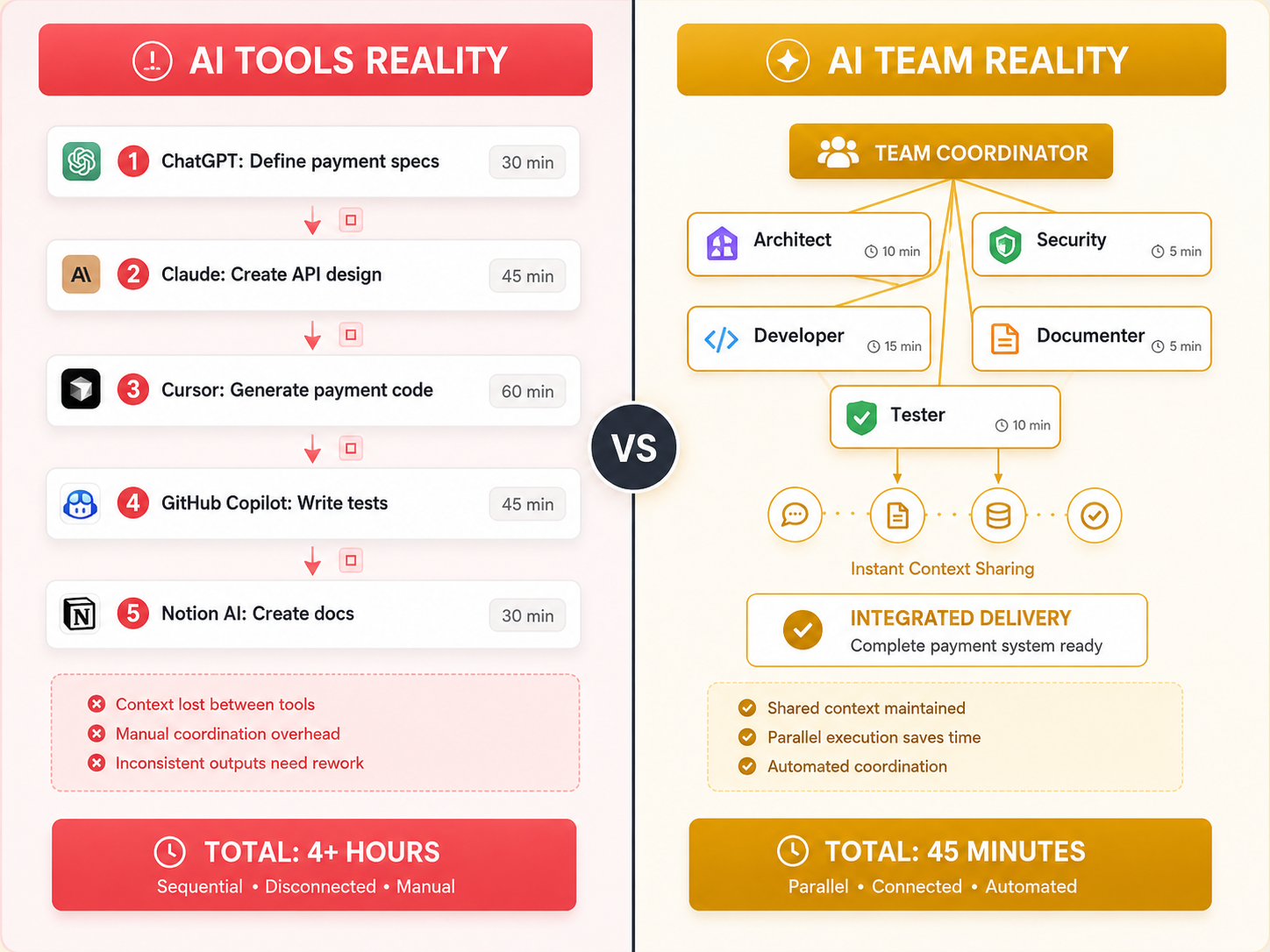
Here's what happens when you have an actual AI team instead of isolated tools.
You say: "Build a payment system."
Your Architecture Agent designs the system and documents why it chose Stripe (those regulatory requirements). The Implementation Agent builds based on that architecture, already knowing all the constraints. Security Agent is reviewing in real-time, catching issues before they become issues. Testing Agent writes tests based on what was actually built, not some imagined ideal. Documentation updates itself.
Everything shares context. Decisions are preserved. No copy-paste. No conflicts.
Honestly, the first time I saw this work, I felt stupid for all the time I'd wasted before.
Patterns We've Heard from Developers
For more insights on building effective AI systems, check out our guide on AI agent orchestration patterns and learn how to delegate tasks to AI agents effectively.
A week juggling isolated tools (senior engineer, fintech)
One developer we spoke to tracked a week of copy-paste between Claude Code, Cursor, and a third assistant. Building authentication alone meant dozens of context handoffs, hours re-explaining architecture, and two conflicting implementations to merge. The merged code felt stitched together because each tool had solved the problem in isolation.
When they switched to coordinated agents sharing one context layer, copy-paste dropped to near zero. Security issues they'd missed while routing between tools showed up in review because the review agent could see the same decisions the architecture agent had made.
A CTO at a twelve-person startup
Another team lead described the before-and-after this way: four coding assistants, zero shared memory, every PR a style fight. Architecture suggestions from one tool, implementation patterns from another, completions in a third voice, review flags in a fourth. After moving to role-based agents with shared context, PR churn dropped sharply because every agent referenced the same design record.
What Tools Literally Cannot Provide
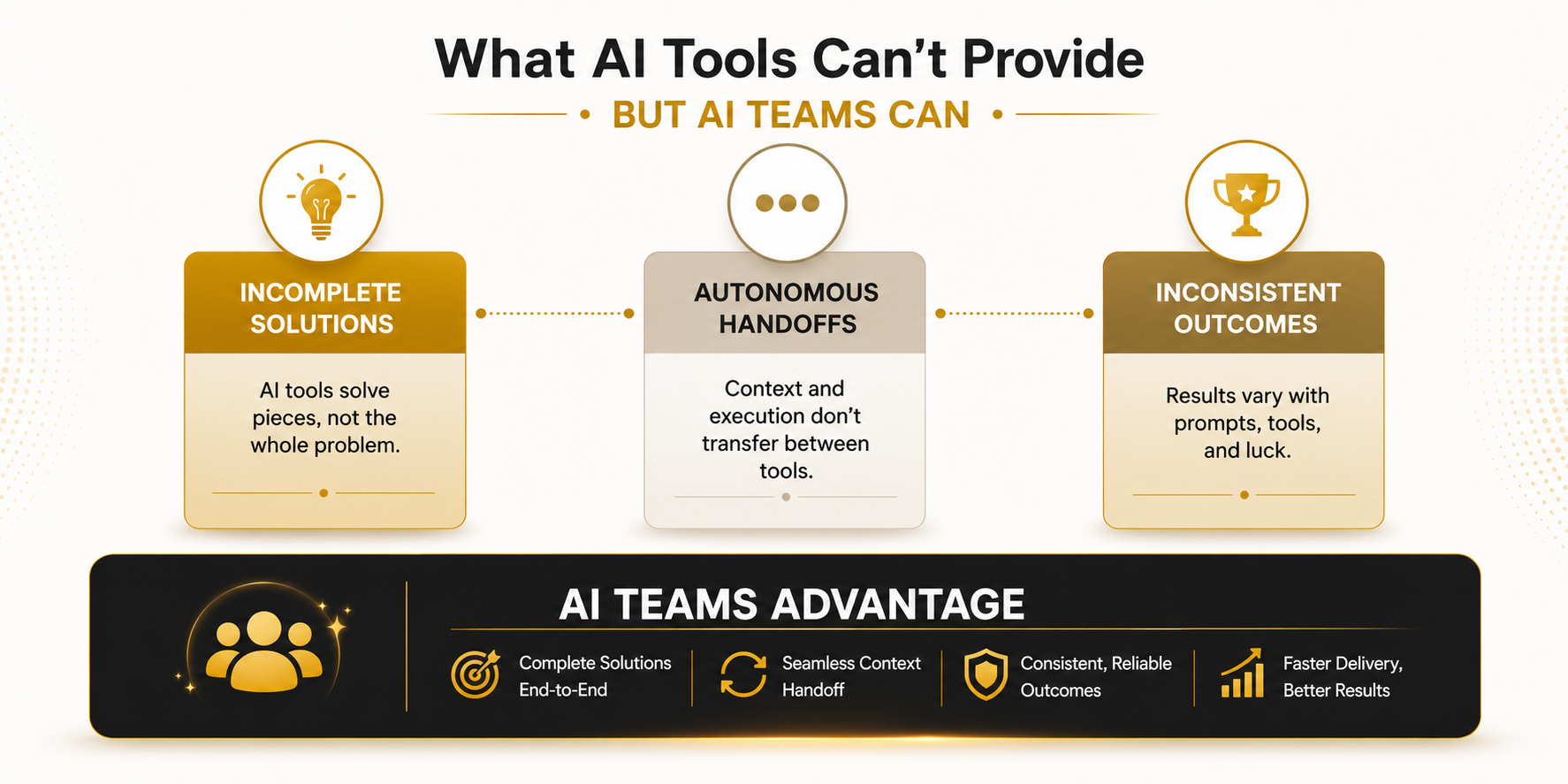
Persistent Collective Memory
With isolated tools: Claude Code forgets your architecture decisions after each session. Cursor has no idea what you built yesterday. Windsurf starts fresh every single time. You explain the same constraints probably fifty times per week. I actually counted once. Fifty-seven times.
With an AI team: Every decision is remembered. Every pattern is preserved. Your Database Agent still remembers why you denormalized that specific table three months ago. It remembers because it matters.
Autonomous Handoffs
With isolated tools: You are the handoff mechanism. You literally copy from Tool A, paste to Tool B, explain context, wait for output, copy again, paste to Tool C. You're middleware. Human middleware.
With an AI team: Spec Agent hands off to Design Agent, which hands off to Code Agent, then Test Agent, then Deploy Agent. No human involvement required. Each agent builds on the previous work. Context flows automatically.
I cannot overstate how much better this feels.
Specialized Deep Expertise
With isolated tools: Every tool tries to do everything. Your coding assistant attempts architecture, implementation, testing, deployment, and documentation. It's mediocre at all of them.
With an AI team: Each agent masters one domain. Security Agent only thinks about vulnerabilities. Performance Agent obsesses over milliseconds. API Agent knows every endpoint's history. And they get better at their specialties over time.
The Compound Effect (This Blew My Mind)
Here's what nobody tells you about agents sharing context.
Week 1: Agents learn your codebase patterns. Nothing special yet.
Week 2: They start preventing mistakes before they happen. You notice fewer bugs.
Week 3: They begin suggesting improvements based on collective knowledge. Things you wouldn't have thought of.
Month 2: Your codebase is more consistent than any human team could realistically maintain.
Month 3: Agents are catching architectural issues before implementation even starts.
This is literally impossible with isolated tools. Claude Code can't tell Cursor about that performance issue. Cursor can't warn Windsurf about that deprecated pattern.
What Changes When Tools Share Context
Studies of developer productivity show that context switches between tasks are common and that switches requiring a change in thinking are especially costly. When multiple AI assistants do not share state, you pay that tax on every handoff between tools.
Teams that move from isolated assistants to a shared agent layer typically report:
Before (multiple tools):
- Frequent manual context re-explanation between sessions
- Inconsistent patterns across files and PRs
- You acting as middleware between tools that never talk
After (coordinated agents):
- Handoffs without copy-paste
- One record of architecture and constraint decisions
- Review and implementation referencing the same context
The exact hours saved vary by team. The recurring theme is less time routing information and more time shipping.
"But I Like My Current Tools"
Look, you can keep them. This isn't about abandoning tools, it's about stopping the copy-paste between them. If you're still figuring out the difference between AI agents and chatbots, start there to understand why integration matters.
Your tools are specialists trapped in isolation. An AI team lets those specialists actually talk to each other.
Think about it this way. You wouldn't hire five developers and then forbid them from talking to each other. That would be insane. So why do it with AI?
How to Actually Start
The Essential Trio
Don't try to replace everything at once. That's a recipe for disaster. Start with three agents:
Architect Agent: Owns all design decisions, patterns, constraints. This one is non-negotiable.
Builder Agent: Implements following the architect's patterns exactly. No freelancing.
Guardian Agent: Reviews everything, maintains quality. Your safety net.
These three eliminate most of the context-switching pain. Like 80% of it.
What Your First Week Looks Like
Day 1: Agents ingest your codebase. This takes time. Let it happen.
Day 3: First successful agent-to-agent handoff. You'll probably stare at it in disbelief.
Day 5: You realize you haven't copied code between tools once.
Day 7: You ship something that would have taken two weeks.
After a Month
By day 30, assuming you don't completely mess it up:
- Your codebase will be more consistent
- Bugs tend to drop as review and implementation stay aligned
- You ship more often because handoffs stop blocking you
- You're actually coding instead of copy-pasting
The Competitive Reality Nobody Wants to Discuss
While you're copy-pasting between Claude Code and Cursor, your competitor's AI team is implementing features in parallel. They're maintaining perfect context. They're learning from every decision. They're getting stronger literally every day.
They're not 10x faster because they're smarter. They're 10x faster because they're not wasting time being human routers.
The Only Question That Actually Matters
It's not "Which AI tool should I use?"
It's "How can my AI tools work together?"
Every tool you use in isolation is wasted potential. Every copy-paste is a failure of integration. Every context re-explanation is time your competitor gains on you.
I know that sounds dramatic. It's also true.
Your Next Sprint Could Be Different
Imagine starting Monday differently.
Instead of opening three different coding agents, you say: "Team, we're building the notification system."
Your Architecture Agent designs it. Your Implementation Agent builds it. Your Testing Agent validates it. Your Documentation Agent documents it.
No copy-paste. No context loss. No conflicting suggestions.
Just consistent, accelerated development.
Here's the Thing
The tools revolution gave us powerful AI assistants. That was phase one.
The team revolution makes them work together. That's phase two, and it's happening right now.
You can keep juggling isolated tools, being the human clipboard between disconnected AI agents.
Or you can build a team where agents collaborate like actual developers.
Your competitors have already chosen. When are you going to?
Ready to stop being the human copy-paste? Build your AI development team with Alook. Let your agents talk to each other so you can focus on actually building.